Friday, February 25, 2011

A Difficult Week


In God’s sovereignty, I wrote about my adjustment to seeing animals die a week ago and the reminder of Christ’s shed blood for me. Since then, He has brought the theme a little closer to home.

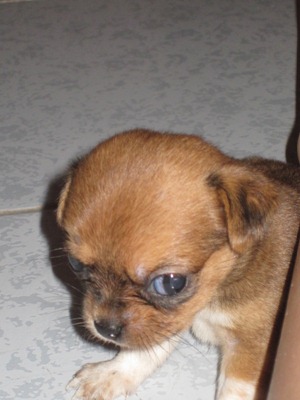
On February 12th, one of our neighbors gave us a cute puppy that was very young. We were hesitant to accept her, but the kids loved her so much and Abigail quickly took over ownership. Julia already had Osito the monkey and Nathanael cared for Snowflake the dog. We landed on the name Glover because of her white front paws.

IMG_5708 (800x600)IMG_5713 (600x800)

We were wary of caring for such a newborn pup, but the mother had abandoned them, so we gave it a go. Abigail had to get up in the middle of the night to feed her. It was a tiring job. On the night of the 17th I heard her whimpering in the middle of the night like I had other nights, but I didn’t bother to get up to make sure Abby attended to her. She was dead in the morning.

We were all very sad. Mistake #2 was letting the kids bury her in the back patio. By the 22nd, there was a foul smell in the house and it was clear that the dog was the source. Glover had to be exhumed, and placed in the trash outside. That was adding insult to injury and we were all very tired that night.

It rained cats and dogs, or maybe monkeys and dogs would be a more appropriate saying for us here. It was after 2am in the morning. What followed was something like a nightmare, and I woke Crystal up to show her Osito dying. It is a memory that is etched in my brain for life. It would be cathartic to write all of the details of what happened, but we decided not to share the how part with Julia and promised her not to tell another living soul either until we decide to first share it with her. In other words, like the now old military policy “don’t ask, don’t tell”.

I decided to wake Julia up and we took her into our room with a candle lit and prayed before I broke the news to her. Her heart was broken as ours was too. We all cried and hugged and talked for a long time. Ultimately, it was a very bonding experience. We discussed trying to bury him or putting him in the trash, but left it up to her. She very maturely agreed to let him go out in the same trash pile that Glover was in too; wrapped in a special blanket.

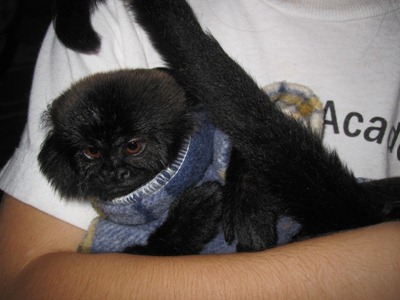
The last two photos we have of Osito are from Chloe’s birthday. Fittingly, they are with Julia holding her.

IMG_5730 (600x800)IMG_5731 (800x600)

What a depressing post right? We are still recovering from the double whammy, and call it a rebound purchase or whatever you like, but we have two new monkeys! Glover was cute, but we only had her for days. Osito meant a lot more to us and won’t easily be forgotten. These new monkeys won’t replace him, but they do ease the kids’ pain and are a lot of fun.

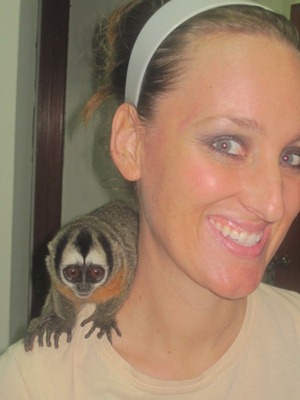
Without further ado…introducing Ginger and Eleanor.

IMG_5792 (600x800)Ginger is Julia’s new monkey. You can find out more about her species at: http://en.wikipedia.org/wiki/Peruvian_Night_Monkey. IMG_5779 (600x800)

Eleanor is Abby’s new monkey (Chloe gets to help too). You can find out more about her at: http://en.wikipedia.org/wiki/Common_squirrel_monkey.

I am sure there will be more pictures and/or stories to come about Ginger and Eleanor, but I better close because Ginger (the nocturnal one) keeps jumping on the computer!

Thursday, February 24, 2011

Photos of our latest jungle trip


If you would like to see photos of our last trip to the jungle from January 15th – February 8th 2011, please check out our Facebook photo album here: http://www.facebook.com/album.php?aid=110795&id=1334529821&l=f40212b1e6

IMG_5560 (800x600)

and for the those that want to see more of those gross photos click here:

http://www.facebook.com/album.php?aid=110803&id=1334529821&l=ed8c0b9941

IMG_5433 (800x600)

Thursday, February 17, 2011

Confessions of a City Slicker

(**WARNING – This post contains gross photos!**)

I grew up in a suburb of Orlando, Florida. My family moved to a suburb of San Diego, California when I was 13. I attended the University of California at Los Angeles in one of the largest cities in the United States. After graduating, I lived in suburbs working behind a computer all day to earn a living. My entire life has consisted of the sheltered suburb and city life.

I had never seen (not counting television) an animal die or be killed; not a cow, not a dog, not a bird, not even a rat. I take that back; I saw a chicken killed in Africa on a mission trip and it grossed me out. I didn’t eat the chicken that night. I had never been hunting before. Road-kill was about the extent of seeing dead animals and I quickly turned away and avoided dwelling on it. While enjoying steak, chicken, and hamburgers just as much as the next red-meat-loving red-blooded American, thinking too much about how the meat got to the table can make me a little queasy. I don’t think anyone would classify me as an animal lover; my only pet growing up was a fish.

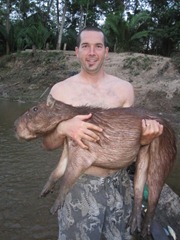
Well, in the first few trips into Ashéninka communities, blood and death has been a common part of life. It has taken some getting used to. The Ashéninka love to eat meat, and although fish is often all there is, hunting and trapping is a vital part of their life. My first experience seeing a dead animal in the community was a capybara, known as a ronsoco among the locals. It is the world’s largest rodent—think of Rodents Of Unusual Size from Princess Pride—and can weigh well over 100 pounds. Hyoni shot one on the island across from Yarina Isla and as he rowed back to shore, I was intrigued and silently nervous at the same time. ROUS?

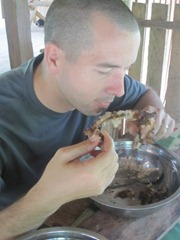
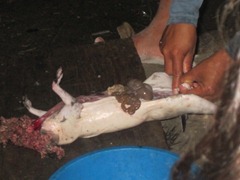
I posed for pictures with this rat on steroids and forced myself to watch the pouring of boiling hot water on the body as the skin contracted and the hair was scraped off revealing a bright white skin underneath. This ain't your typical science class dissection!That wasn’t nearly as bad as the de-gutting and hacking of the carcass—more tamely called field dressing. The meat was surprisingly good, but my first experience of blood, guts, and death was eye opening. Chunks of overgrown rat meat anyone?

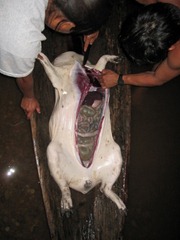
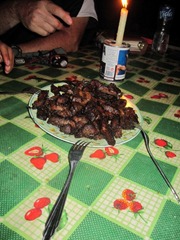
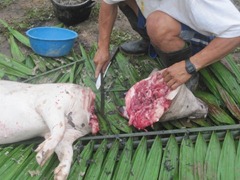
A couple pigs were killed and cut up in similar fashion.She'd lose her head if it wasn't attached. Oh wait...it isn't! I helped drag one of the freshly dead ones and the other—killed on a separate trip—had to be hammered in the head after being shot a couple times with an air gun. The sound of hammer and skull clashing was gruesome, but again the meat tasted great. Best ribs south of Memphis!There have been various birds mixed in, but that is hardly as upsetting and the meat doesn’t taste as good. On the latest trip, Hyoni’s traps have done the hunting for us and two añujes have been caught. An añuje is another rodent creature, much bigger than a rat, but not nearly as big as the capybara. The first one had its head blown off and the second had its back blown off. That explosion of flesh is where the head used to be!Both were incredibly gruesome, but the leg meat was a special treat.

The most difficult of all was the cow that was killed for the training conference. We waited for a couple hours to get the cow in its corral, but when it wasn’t entering, it was decided to shoot her instead. I heard the shotgun blast and we started looking the cow as it ran away. Blood was dripping in the mud, but the cow was “utterly” unaffected because the shot had hit the cow near the utters. I was an eyewitness to the second blast and it still didn’t go down. Ultimately, the cow had to be roped to the ground and Hyoni jabbed a Rambo-style knife into the back of the neck and began cutting the head off. I don't think it was totally dead until some time during the beheading :(.Everything about this sawing of the cow in fourths was bigger, grosser, and harder to watch. The kicker was having to carry a quarter of the cow on my shoulder for a 30 minute hike back to the boat. Smiling on the outside, nearly throwing up on the inside.Yes, that was a 30 minute hike through the jungle carrying somewhere in the neighborhood of 100 pound of bloody, freshly dead flesh. In the end I was exhausted, covered in sweat and blood, reeked terribly and couldn’t believe what I had just experienced.That's blood on my shoulders and arms. I washed the shirt I was wearing in the river, but it was still thoroughly stained. As with most of my other jungle animal death experiences, the meat tasted great!

I had never been covered in blood like that before and reflecting back on it, I am reminded of the sacrificial system of the Bible. Animal death and blood was a common sight in Old Testament times in an effort to cover the sins of the people of Israel. No matter how many animals were sacrificed or how much blood was spilled, it was never enough to keep up with the sins that were being committed. It wasn’t until Jesus came to earth and was the final perfect bloody sacrifice on a cross did we receive the opportunity to have our sins forgiven once and for all. His blood covers us and makes us clean and sinless in the Father’s eyes. I may never get used to the blood and death that is so much a part of life in the jungle, but I sure am thankful for my Savior’s blood and death for me. The greatest sacrifice of all!

Indeed, under the law almost everything is purified with blood, and without the shedding of blood there is no forgiveness of sins. (Hebrews 9:22 ESV)

Monday, February 14, 2011

Jungle Journal

Wednesday

January 19, 2011

Late afternoon, just after climbing the hill from the river

Yoselin spent most of the afternoon crushing lemon halves against her head. Her hair was laden in pulp and I wondered why. Quilmer said it was for relief. Citric acid kills lice. So now I know.

Thursday

The rain did not stop all day. I did not want to leave the mosquito net because of tiny, stinging gnats, so Jujee, Abby, Nano and Chloe joined me. We read our books together, worked through math, memorized facts and listened to the rain. When I saw Alejo chopping firewood in the fury of the downpour, I assumed they must’ve run out. They needed to eat.

Minutes later, he and little Christian were dumping armfuls of slender logs on our platform. He was cutting wood for us.

I remembered how Jeremy said to chip away the top layers because the inside would not be wet, and with a little diesel fuel and trash wrappers we could count on a strong fire in little time. We did, but the in little time part did not work out as planned.

Starting fires in rain that slants sideways is nearly maddening.

Friday

The rain that wouldn’t stop, didn’t stop again through the night. When we woke this morning, the river had risen some 20 feet and the hill above the river that winds to our hut was under brown water. Everyone was saying these kind of floods happen every 5 years or so. Hyoni’s canoe is gone, but all the motors are safe.

Saturday

IMG_5449 (640x480)

Abby Gracie brought me the oil for frying platano. One of us didn’t screw the lid on tight. It was not worth trying to expose the culprit. It might’ve been me. Nevertheless, Black ants were floating in that oil-- the precious oil! I figured we’d fry the ants with the plantain and no one seemed to mind.

Sunday

We made a list together, all of us huddled in the crudely painted wood church at Yarina Isla. 18 passages that pertained to God’ promises to us: I have overcome the world. Be of good cheer. I will never leave you. Michael scratched them in chalk and we all copied them into our notebooks.

The men carry hand-woven bags to these Sunday services. Women carry the children. Many people have torn-up, weather-beaten Bibles, chewed pens and dirt-covered notebooks they’ve bought downriver. We sit on wooden slabs in the dirt. Men in the front-- women and children in the back. Sickly dogs and sometimes chickens come and go. We sing heartily. There was a guitar today, but it didn’t seem to be playing the same songs we were singing. And the drum. Someone generally plays a drum. Sometimes people are barefooted, sometimes not. Yesterday Nellie, in her sixties, wore two different flip-flops. They might’ve belonged to the same foot.

We were quite satisfied to have compiled such a list of promises and nearly everyone was copiously note-taking. It made my heart happy. I made sure to take copious notes, too. I wanted to be just like them.

Tuesday

Excessive rain makes it nearly impossible to dry clothes. We wash them in the rushing mud, then hang them on a line if the sky is not threatening rain. Within minutes, however, a sudden, unsuspected downpour is feeding the earth and dancing on the trees, and I see Manuela run for her clotheslines. This happens over and over… I am in language study, sitting on one of those hard benches with Ema, and it makes little sense to stop.

Michael and Julia and Abigail race for the clothes and hang them along the fence around our platform. There is also zig-zagged rope from the our wooden ceiling constructed under the Yarina thatches, so when my talking watch says Son las tres en punto , (It’s 3 o’clock) I go to the hut to see what has become of wet laundry. Re-hung along the half-walls, zig-zagged lines are drooping under the weight. 3 days and the same clothes are still wet. Chloe is wearing Abigail’s stretchy pants again because every one of hers is wet on the line.

IMG_5466 (480x640)


After class today, Julia and Abigail boasted of their newly-constructed pulley system which hoists clothes to and from the roof to dry, with seemingly little effort. They were elated. I was distracted. I find that I am often distracted.


Thursday

I can always hear Alejo and Ema singing and worshipping long before sunrise. Their voices are always first to arouse my consciousness. I wake while it is somewhat dark to read and study. After my heart and mind are full, I leave the mosquito net to start the fire. Some mornings it is easy and takes little effort. Others, when the wood is wet and my ambition sags like those weighted clotheslines, a simple fire is a massive undertaking. So much work for oatmeal.

After oatmeal, the girls and I fill three large round bowls with water and wash the dishes. Nathanael sweeps the floor and feeds animals. Left overs are thrown out to woeful dogs and Mother hens with their trailing, devoted broods. Osito, the monkey, can never wait for leftovers, and always shares a bit of whatever Julia’s eating. She feeds and cleans up after and cares for Osito, and he sleeps with her every night, unfailingly entrusting himself to her.

The first four hours of the day Michael spends in language study. During this time, the rest of us do school, too. Sometimes under the mosquito net, Sometimes sprawled out across the floor. Every book and pencil and notebook is lugged back and forth in a water-tight bin between Yarina Isla and Pucallpa.

The thought of studying along the riverbank was always so intriguing to me, but we’ve found it thoroughly impossible to accomplish anything. We must be in our family quarters with the door shut. Even then, little eyes poke through the slats, and toes squish under the door. Neighborhood children sit on our platform waiting…

Que vas a cocinar, hermana? (What are you going to make, sister?)

Ya has terminado tus clases? (Have you finished your classes already? )

They wait and wait and wait…

When we’ve finished, it’s time to start another fire and prepare lunch. We might peel and boil yucca or make soup. Nathanael and Chloe gather cilantro and peppers along the shed. Julia finishes copying a passage from one of the books she’s reading. Abigail details aloud every transaction of whichever story she’s reading…

We eat. I leave for my four hours of language study across the dirt path…

When the talking watch says Son las cuatro en punto (it’s 4 o’clock), I close my notebook and turn the recorder off. We gather our buckets, soap bars and laundry and head to the river. The children are racing and tripping and squealing… we wash clothes and bathe. Michael jumps from the bank into the cold mud. Abigail follows him with Osito on her shoulder and the puppy swimming at her side. Nathanael swims to catch up, and Chloe calls from the hillside, “Wait for me! Wait for me! Daddy, hold me! “

When the sun slips behind towering trees, Michael hauls three 5 gallon buckets of water on his shoulders, from the river or the brook. Those are poured into a big trash can and serve as our water supply for the next day. Some is poured into our water filter, while the rest is used to wash dishes and hands and cook.

As evening falls, the fire is warm and we gather around with other families to share fish caught in the net, rodents from the trap and details from the day’s events. I bring rice. We eat until our bellies are full and moan about the deliciousness of it all, lounging in the hammocks. The children entertain us with their stories and antics and we laugh until our eyelids are heavy when someone says Amayeve Ashéninka for We’re going to sleep. Everything stops… and the day has ended.

It all sounds so easy.

It is not.

These first six months living in Peru, I’ve often found it difficult to say what I’m thinking, partly because I don’t know what I’m thinking much of the time. Learning to live differently than I lived before has been more demanding than I could’ve predicted, but I’ve a sneaking suspicion I might be creeping out of this dense fog of complete shock…starting to form ideas, measure observations...

The stark nature of my person-ness, who I am and what I believe, has been violently stripped from me without my even knowing… Like a mummy wrapped in 50 pounds of cloth, it is as if someone found where that strip of cloth ended and has been pulling on it for 6 months. I’ve been

spinning

spinning,

spinning

… at so fast a speed, I thought I was standing still—hadn’t moved. And now—everything has stopped. In my mind I am standing completely still and it is really so!

The sweetness of following God into a dense, viewless fog is less-frightening than I had thought. Being loved by Him, and led by Him, talking with Him, and listening to Him makes the unseen an adventure. It makes not knowing and not understanding alright. I don’t have to know. I don’t have to understand, or be good at either of them. I’m just following.

Where there is nothing to prove, there is nothing to lose. All the world is before me, and yet does not depend on me. The world does not revolve around me after all… I think Michael will be especially glad to hear this.

IMG_5528 (640x480)

Thursday, December 23, 2010

Like Ema’s Smile

Rain pelts Yarina palms, whipping and beating at the thatch-roof. I feel no water. Remarkable the way these dry, layered palms cinch in pairs with long strips from tall trees. They are as a fortress.

Night has fallen. We are snugly tucked under the mosquito net. It looks nothing like the ones in department stores back home: wide and long, it’s like a cube of airy netting tucked under the slab of foam that supports our sleeping bags.

Above the mosquito net, I hear bats. Children left uncovered awaken with a stream of blood trickling from their scalp. EIMG_4633 (600x800)xposed heads are open targets for such flesh-biting, darting, winged creatures. Being that their homes are tucked among the thatches overhead, this white cube of netting provides sure relief.

I have heard that snakes enter mosquito nets rather effortlessly. Better not to think about snakes before bed. I dismiss the thought, and smell the rain instead.

As if we are under a waterfall, it whips and sloshes through the mud surrounding our hut. Down the hillside it rushes. Through Aunt Dena’s tidy rows of pineapple, drenching her mint and lemongrass which stretches out of the brown earth, the water follows a predestined trail carved by machetes through hard dirt. A hungry stream groaning toward the rising river.

These same machetes hack deadly snakes, slash pineapples and hoist hands of banana from their lofty places. It cultivates the earth, clears the weeds, and carves trails through fierce, raging undergrowth which wars to dominate every path: from one community to another, from gardens to huts.

Time for laundry. After scrubbing fruit and charcoal stained clothes that have been soaking in rankish river water, with a pasty, turquoise laundry bar, we dip the clothes into the current, watching as cloudy white suds disappear into the cold, moving mud. I close my eyes, face turned up toward the sunshine. I suck in a deep, contented breath of soap and mud and wet sand. The sun, the blue of the sky, and the green of everything growing above the river is intense and alive. And it seems the blue is holding everything together.

In language study, I learn there is no name for the color blue. There isn’t a concept of blue? But what of the sky? I resolve to ask the question again when I may string together a few more vocabulary words in Ashéninka. No blue? There are words for black and green and red. One color for red is basically translated raw. The raw that describes a freshly slaughtered animal. No blue-- but raw, blood red. I note this observation in my notebook, feeling somewhat important-- like an anthropologist. I am very satisfied. I close the notebook, and hold it up to my language tutor, Ema. Red, raw red? I question in Spanish-- is raw red the color of my notebook? No, she insists raw red is purer and my red notebook is really a sort of pink. Names for shades of red, but no name for blue.

415 (600x800)

I watch Ema. I record her voice that I may wake to her words each morning, at the push of a button. It’s as if she is with me when she is not. Such a tiny, barefoot wonder. Few teeth to speak of. Coarse, unruly hair. Does she own a shirt without holes, or shorts that haven’t been crudely stitched in odd places? I have yet to see either.

I stare at her as she speaks into the funny little box I hold near her mouth. Oh my, but isn’t she beautiful! Content. Wise. Laughing easily. She possesses peaceful resolve. Neither time nor person can steal that certain, impenetrable beauty that is hers alone. And when she smiles! Is there anything so lovely as her smiling contentedness? I include this in my notebook. Ema’s smile.

I often think of her smile at unusual times. It depends little on the ease or predictability of circumstances, for she has neither. Clearly perplexing is that smile, when she launches hushedly into her sagas… her 20-something daughter having died, her own debilitating sickness and those speechless fits of fever, death hovering. Her voice is nearly hoarse as her stories unfold, as if she were looking around to see who might hear…

So cautious they are-- and skeptical-- especially of us. Our skin is a different color. Our feet are so big, and we stand a head taller than most. We are dangerous. There are stories of the white man, and every person seems to know the same one: White Man comes to slice, then peel off their faces, rendering them unrecognizable. He who cannot be recognized can never be found. The white man steals their children and peels their faces, too, then sells their organs. We are the foretold face-peelers.

But not everyone thinks this way. In the clustered spread of huts that is Yarina Isla, we are surrounded by a loving Grandfather who is from another tribe, and his son, Hermano Hyoni (Yoni) who is married to an Ashéninka woman. They have four children, three girls and a boy. They are believers.

When the children have all bathed, and cleanish clothes are all strewn about, darkness begins to settle over the river. Everyone is hungry. I make an extra large pot of soup. The whole eggs have been carefully dropped into a boiling broth, and when they are hard, it will be ready to serve: a fat pot of potatoes and peas and bit of corn in a creamy broth. The fire hisses and sputters when soup spills over the side of the blackened pot.

Behind the potato-pea-corn and cream soup is another toppling pot crowded with slivers of freshly-cut yucca. Every meal must include yucca. A dug-up root, it is still earth-encrusted when the rough, brown bark is hit with a machete, peeling away two layers of protective bark. The starchy center settles into tepid water.

Little MacDina comes toddling toward the fire. Her face is layered with runny nose, caked-on dirt and smeared plantain. Lice crawl from her head. And still, she sparkles, eyes twinkling while she babbles jibberishly. I tell her to sit down and wait for the soup. She throws her doll on the floor and screams. She hits the monkey with her doll. Then she obeys.

Hermano Hyoni is sprawled in the hammock, while his daughters, Laura and Yoselin are pushing him. Baby Caleb is crawling toward a whirring bug that has hit the floor, and is his to smash in-hand. Hermana Manuela gathers some bowls and tells the children to call Abuelito. The soup is ready.

Candles resting atop cans of tuna and evaporated milk are spread throughout the hut. We eat soup by candlelight. Sometimes we are silent. Sometimes everyone is talking at once. Sometimes Hermano Hyoni is playing a guitar, and other times Manuela is preparing the bird or the rodent or the fish he’s caught. Other times we are praying together, or studying the book of 2 Peter. We sing and laugh and listen to one another. And always, there is a certain sweetness in the mysterious clashing of our different worlds. This melding is at times uncomfortable. Awkward. Complex. For them, and for us. But without fail, it is always something beautiful. Like Ema’s smile.

To see more pictures from our latest adventure click here.

Monday, September 13, 2010

Some of September

The Embankment

Rain is beating against the red earth (Pucallpa is Quechua for red earth). Dust becomes thick, hungry clay swallowing up any wheels that try to pass through unpaved streets. Maybe the dust isn’t so bad, I’m thinking as Uncle Marty’s (as the children affectionately call him) truck is sloshing across red mud and begins to sink into a ditch.

An eccentric, elderly Peruvian woman without teeth is in the front seat directing us to continue on this road so that she can get home. Her backward bandana rests on gray curls and high, strong cheekbones. Wearing richly pink pants, and a shirt of many colors, she’s insisting that we move forward, saying aloud in Spanish, “All powerful God, Help us!”

We are helped.

Bad Water

The water tank on the roof is growing algae. Maybe this has something to do with the persistent high fevers: Chloe’s reached 105. Michael’s: 104. With this water, we have cooked, bathed and washed dishes and vegetables. But now the man on the roof is draining the source of our expenditures and foul, green water shoots out through two protruding pipes from the top of the house down to the sidewalk. Sounds like rain.

Groceries

Heavily-loaded canoes and other boats, whose names I don’t yet know, are pulling into the muddy river bank unloading stock after stock of green bananas and plantains. There are sweet-rather-than-sour lemons, and all shapes and colors of hot peppers. In the market stalls, beautifully woven hammocks hang from tin roofs. In others, there are beheaded turtles, whose limbs are separate from their shells.

Snake in a rusty cage. Ducklings and chicks. Quail eggs in jars. Tiny, firey monkeys whose red ribbons tie them to the cages they sit upon snarl, and make threats to passers-by. Quechua women drag carts through the meat stalls with their smooth, wooden spoons and bowls, weaving in and out of hanging pigs’ feet and giant black and white slippery fish piled in sloppy stacks. As the sun crawls higher into the sky, sweat drips from our noses and the bags of garlic and peppers, lemons, meat and mandarin oranges begin to make our shoulders ache. The moto-taxis plunge through the rocky dirt paths leaving little room for street-crossing. 

One father is wearing his tiny baby, while driving his motorcycle. Another small toddler is sitting in her pink walker which is tied to the back of the motorcycle seat resting on the bench of the moto-taxi. We begin to walk, then race through open holes in the traffic pattern, inhaling gusts of diesel fuel. We are on the other side now. There are woven brooms and hanging kitchen sinks from awnings. Painted, peeling turquoise wood panels are made into towering shelves that hold laundry soap beside giant sacks of loose flour and sugar and hard corn.

Strike

Later in the afternoon, Aunt Dena serves fried fish and giant kernels of buttery corn mixed with red pepper and smoked pig meat. There is garlic rice and homemade apple pie. We are celebrating Michael and Uncle Marty’s safe arrival from Lima. Having driven the usual 16 hours in 21, given a two hour road-construction stop and mile after mile of striking cocaleros, their safe arrival calls for a feast.

A convoy of trucks protected by police in army fatigues carrying semi-automatic weapons led the way while cocaine-growers and their sympathizers launched rocks from the hillsides at the Land Cruiser Uncle Marty and Michael were driving. The road was littered with burning rubber tires. For weeks the main highway had been impassable due to coca-growers (whose product is processed into cocaine) on strike. As soon as the newspaper deemed the road clear, Michael and Marty flew the hour to Lima to pick up our vehicle, making the long trip back home with a car load of supplies from Lima…

They hear a heavy thud on top of the car. They’ve been hit. And later-- hit again on the side of the car door…

Home in Pucallpa, Dena and I have lost communication with them and it has been many hours. We are growing restless-- uncertain…

Sunday

It’s been 23 hours. Still--no electricity. A little frog is hopping across the dark house, after finding his way through the open front door. The windows are open, too. We are sprawled with pillows across tile beside the door. Usually fans provide relief-- there is no air conditioning. But even the fans sit dormant tonight without power.

Everyone in my family is sleeping. My eyes are closed. I imagine a warm wind beginning to move through darkness. I am recalling the events of the day: learning to drive that stick-shift Land Cruiser, shifting gears without the clutch only to be firmly scolded by Michael: You’re not doing what I say!

Me: I can’t even understand what you’re saying. That’s not my learning style. I do much better with trial and error.

Michael: You can’t say that about driving! This is not about learning styles. We’re trying to stay alive here, Crystal! Listen to what I say and do it.

I am laughing.

He scolds again: This is no time to be laughing. You’re in the middle of the street and everyone is staring at you. You’re blocking traffic.

He tells the people to go around me, and I try again to shift into third gear. I cannot stop smiling. He’s always great at giving directions. My ability to heed them under pressure can be somewhat lacking. Still, I cannot stop smiling. So he does too.

For in union with Christ, you have become rich in all things… 1 Corinthians 1:5


Pictures from some of September can be found here: http://www.facebook.com/album.php?aid=75281&id=1334529821&l=1419c97b21

Tuesday, August 31, 2010

The First of Two Homes

Pucallpa

Men without shirts are sitting under brightly colored umbrellas with typewriters conducting business: the typing-out of formal documents or solicitations for a small fee. And on another street not far from this one, there are crowded stalls of hanging light bulbs and machetes and rubber boots and long, fat tubes of chorizo. These streets have no lanes. Motorcycles weave in and out of moto-taxis. There are few cars, few trucks.

Motorcycles are often piled high: women in high heels sitting side-ways holding a small baby in one arm and plastic bags of plantains and potatoes in the other. One or two other small children sit between them and the driver as they dart effortlessly through dusty downtown stalls stopping for one thing or another until the motorcycle is lost in black and yellow and white bulging plastic bags, and sweating bodies. There are also moto-taxis.

A moto-taxi is a motorcycle whose attached 3-foot seat is supported by the two wheels underneath that attached seat. All of us get around town on that one 3-foot seat. Michael gets in first with Nathanael on his lap, then Julia, with Chloe on hers. I get in last with Abigail on my lap and Michael and I hold our bags of bars of soap and scrub brushes and such with our free hand on a little shelf attached to the back of the moto-taxi. Because it is dry season, there is much dirt and little rain. Riding into town, even our teeth become covered in a spray of red earth. It can burn the eyes and make breathing a bit labored every now and again.

The Neighborhood

By the time we arrive on our little street where the corner market stands-- painted a peeling, lovely peach color-- we climb out and pay our driver the price we came to an agreement on in the beginning. Under our feet crunch fat, brown mango leaves from the cluster of tall trees jutting out from littered earth. We follow the mango leaves to our black gate set in a pale aqua cement wall. This must be the third or fourth layer of paint this wall of cement and brick has known. Someone has taken a blue crayon and drawn a wiggly line across that whole front wall. I’m not sure if that someone shares our last name or not.

Instead of being separated by a street, our houses face each other separated by a sidewalk and some red dirt full of incrusted bottle caps and candy wrappers from the little market across the way, and a stray dog or cat.

The house in front of ours has a tall picket fence and mannequins with pink, green and blue-colored hair. If the multi-color-haired mannequins are out, our neighbor’s little shop is open for business. Her screened-in veranda is piled with plastic wrapped sandals she’s designed and labeled, clothing, purses and some jewelry. It’s quite an operation.

At the corner, across a dirt road, Maria sets up a few tables covered in cloth, chairs and a hanging light bulb or two. She lays out a spread of boiled yuca and bananas. There’s usually rice and potatoes. The meat cooks on the fire there on the street corner. There is always a crowd.

The Roof

On the rooftop, there is much wind, little dust, and the tops of palms, almond and mango trees in view. An airplane leaves the airstrip not far away. Driving, Latin rhythms absorb the usual roar of the competing moto-taxi engines.

Our water supply is also housed on the roof: a stout, blue, routinely-filled water tank. While we cannot drink from it, we do bathe in and cook with it. We use this water for our laundry. Beside the blue tank are electric-looking cables strung in zig-zags where we hang the clothes and sheets that have been hand washed, stomped on, wrung dry, and piled tall--still dripping--into a bucket and carried up to the roof to dry in the hot sun...

The first home.

Pucallpa.

Yarina Isla

The next: Yarina Isla.

In October, we will begin to travel. For up to a month at a time, we will be living in Yarina Isla, a tiny jungle community along the river, reached after a long, dusty road trip and boat ride down the river. Our home there is underway: a raised wooden floor built on stilts covered by thatched palm. There are no walls. Water must be gathered from the river and boiled. Wood must be cut. Jungle brush cleared, and yuca and pineapple planted. Yarina Isla will be our next home.